
Every Bodacious Knife starts with our story, a journey that began in 2002 in a small family workshop in Wazirabad, where knife making has been passed down through generations. Today we are a fully registered USA knife company, and every blade we ship is made with the same care we learned as kids.
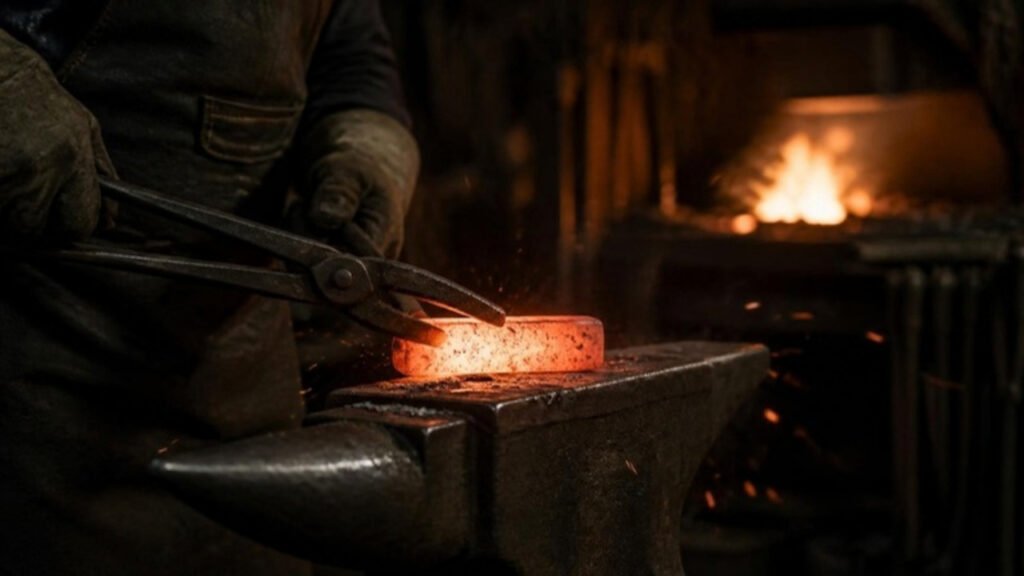
There is nothing quite like the sight of red hot steel on an anvil. In this short knife forging video you can watch the forging of a Damascus knife in our workshop, from the glowing steel bar to the shaped blade, and see why hand forged knives are so special.
Watch: Forging a Damascus Knife
Press play and watch real blacksmith work. The video shows a glowing bar of steel being prepared on the anvil, with powder added to the hot metal, steel being cut with an angle grinder in a shower of sparks, a heated blade bar being shaped under a heavy forging press, and an etching bath with ferric chloride that brings out the pattern. These are the early steps of Damascus knife manufacturing.
What Is a Damascus Knife?
A Damascus knife is made from Damascus steel, also called pattern welded steel. Layers of different steels, often 1095 and 15N20, are stacked and forged together into one solid bar called a Damascus billet. When the blade is later etched, the layers show up as the flowing pattern that Damascus is famous for. You can read the full story in our guide on how Damascus blades are made.
The Forging Steps You See in the Video
Step 1: Heating the Steel
The steel is heated in the forge until it glows bright orange. At this temperature the metal becomes soft enough to be shaped and, in the case of layered steel, to forge weld into a single piece. This is the heart of knife forging.
Step 2: Flux and Forge Welding
When making Damascus, a flux powder such as borax is commonly added to the hot steel. Flux keeps the surface clean so the layers can bond during forge welding. This is one of the key skills of a Damascus knife maker.
Step 3: Cutting the Steel
Bars and billets are cut to size with an angle grinder, and the sparks show how hard the steel is. Accurate cutting prepares a clean blade blank for the next stages.
Step 4: Shaping Under the Press or Power Hammer
A heavy forging press or power hammer does the heavy work, squeezing and stretching the hot steel into the long, flat shape of a blade. Machines save time, while the maker controls every move. Learn more in our article on power hammer forging.
Step 5: Etching With Ferric Chloride
Once the blade is shaped, it is cleaned and placed in an acid bath of ferric chloride. This Damascus etching eats the different steels at different rates, so the layers appear and the pattern is revealed. The blade is then neutralized and polished.
What Happens After Forging
Forging is only the first part. After it, the blade goes through heat treatment and quenching to harden the steel, then blade grinding to form the bevels, final sharpening and polishing. Then we fit a handle, such as rosewood or stag horn, and a leather sheath when it is part of the knife. See the whole journey in how Bodacious Knives are made.
Why Choose a Hand Forged Damascus Knife
A handmade knife forged from layered steel has strong edge retention, a unique pattern, and a character that mass-produced knives cannot match. Our custom Damascus knives are popular for hunting, the kitchen, camping and as gifts.
Custom, OEM and Wholesale Damascus Knives
We also work with businesses as an OEM knife manufacturer. If you need custom knives, private label knives or wholesale knives, visit our wholesale and bulk orders page or request a quote.
Frequently Asked Questions
How is a Damascus knife forged?
Layers of steel are stacked, heated, treated with flux and forge welded into a billet. The billet is then forged, folded or twisted for the pattern, and shaped into a blade before heat treatment, grinding and etching.
Why is flux used in forging?
Flux protects the hot steel from oxidation and cleans the surfaces, which helps the layers bond properly during forge welding.
Are your Damascus knives handmade?
Yes. Bodacious Knives are handmade by experienced craftspeople, and we are a registered USA-based company that ships across the United States.
Final Thoughts
Watching hot steel become a blade shows the skill, heat and patience behind every Damascus knife. If you want a knife made with that kind of care, explore Bodacious Knives or tell us about the custom piece you have in mind.
Explore our collection: Hunting & EDC Knives | Kitchen Knives | Pocket Knives | Swords | All Categories