
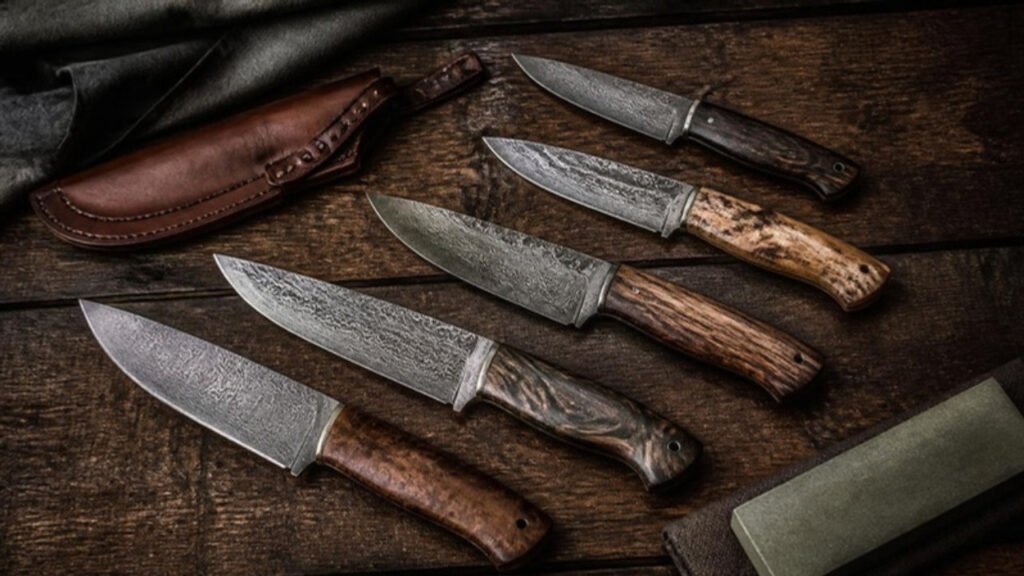
Damascus steel knives are among the most admired blades in the world, and also among the most misunderstood. Are Damascus knives really better? How can you tell a real Damascus knife from a cheap copy? And how do you keep that beautiful pattern looking sharp for years? This guide answers all of it in plain language, from a family workshop that has hand forged knives since 2002.
What Is Damascus Steel
Modern Damascus steel, also called pattern welded steel, is made by stacking layers of different steels, heating them and forge welding them into one solid billet. The billet is then drawn out, folded and twisted, and the process is repeated. When the finished blade is etched in a mild acid, the layers show up as light and dark lines, giving the flowing Damascus pattern everyone recognises.
The name comes from historic wootz steel, which was made in a different way. Today the word Damascus is used for pattern welded blades that give a similar rippled look. Want to see how it is made? Read our step by step guide, Knife Making: Forging a Damascus Knife From Red-Hot Steel.
Are Damascus Knives Good
A well made Damascus knife can be excellent. By combining a hard, edge holding high carbon steel with a tougher steel, a bladesmith can build a blade that is strong, takes a keen edge and looks unique. Many makers use layers such as 1095 and 15N20 high carbon steel, a popular pairing for good contrast in the pattern. Keep in mind that the quality depends on the maker. Good forging, correct heat treatment and careful finishing matter far more than the pattern itself.
How to Identify Real Damascus Steel
Because Damascus is popular, fakes exist. Here are simple checks that help you spot a genuine Damascus knife.
- The pattern runs through the steel. In real pattern welded steel, the layers are part of the blade, so the pattern continues around the spine, the edge and the tip. If the design only sits on the flat surface, it may be printed or laser marked.
- No two blades match exactly. Hand forged Damascus has natural variation. If every knife in a listing has the identical pattern, be careful.
- The maker explains the steel. A trustworthy seller tells you which steels are used, such as 1095 and 15N20, and how the blade is made.
- The price makes sense. Hand forging takes time and skill. A very low price for a large blade is a warning sign.
- The pattern is crisp. A properly etched blade has clear lines you can feel as a very slight texture, not a blurry print.
Damascus vs Stainless Steel Knives
Stainless steel is easy to maintain because it resists rust. High carbon Damascus steel usually asks for a little more care, but it rewards you with a sharp edge, easy sharpening and a pattern that is unique to your knife. If you want zero maintenance, stainless is fine. If you enjoy owning a handmade tool with character, Damascus is hard to beat.
Which Damascus Knife Is Right for You
- Hunting and camp: a fixed blade Damascus hunting knife is tough and easy to clean. Read our hunting knife buyer’s guide.
- Everyday carry: a Damascus pocket knife is light and always with you. See our story on the Damascus folding pocket knife with rosewood handle.
- Kitchen: a Damascus kitchen knife or ulu knife makes cooking a pleasure. Browse our kitchen accessories.
- Gifts and collecting: a handmade Damascus knife gift with a wood handle and leather sheath is a lasting present.
Not sure whether to choose a folder or a fixed blade? Our guide on fixed blade vs folding knife will help.
How to Care for a Damascus Knife
- Wash by hand with mild soap and warm water, and dry it right away. Never put it in a dishwasher.
- Wipe the blade with a thin coat of food safe or light mineral oil, especially before storage.
- Store the knife dry, in a sheath with airflow or in a drawer, not in a damp place.
- Do not leave it wet, or in contact with acidic foods, for long.
- Use the knife for cutting, not prying or twisting.
- Sharpen with a whetstone at a steady angle. Our guide on how to sharpen and maintain your knife shows how.
A light patina is normal on high carbon steel and many owners like it. Deep rust spots can usually be removed with fine abrasive and oil if you catch them early.
Damascus Knife Buying Checklist
- Ask which steels make up the blade.
- Check for a full tang for strength.
- Look at the handle material and how the handle is fitted and pinned.
- Make sure a sheath is included for fixed blades.
- Choose a maker who shows the process and stands behind the work.
Handmade Damascus Knives From Bodacious Knives
Bodacious Knives began in 2002 in a family workshop in Wazirabad, and today we are a registered USA-based company shipping worldwide with tracking. Explore our Hunting Knives and EDC collection, ask for a custom design with a quote request, or see our wholesale and bulk orders page if you are a retailer.