
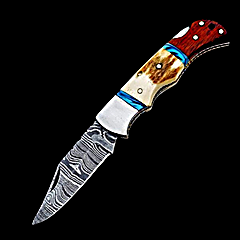
Every Bodacious Knife starts with our story, a journey that began in 2002 in a small family workshop in Wazirabad, where knife-making has been passed down through generations. Today we are a fully registered USA knife company, and every blade we ship is handmade with the same passion and precision we learned as kids.
Damascus steel is famous for the flowing, wave-like Damascus pattern that runs across the blade. Many people think it is just a design added for looks. In real Damascus steel knife making, the pattern comes from the steel itself and is created by hand, one layer at a time. In the video below you can watch the Damascus knife manufacturing process and see how Damascus blades are made.
Watch: Our Damascus Knife Manufacturing Process
Take a minute to watch the reel. It shows the real work behind our handmade Damascus knives, from raw steel to a finished layered steel blade with its own one-of-a-kind pattern.
What Is Damascus Steel?
Damascus steel, also called pattern-welded steel, is made by layering two or more types of steel and forging them together into one solid bar. When the blade is later etched, the different steels react differently and the layers show up as a genuine Damascus pattern. A common combination is 1095 and 15N20 steel: 1095 is a hard high carbon steel and 15N20 adds toughness and a bright contrast line.
How a Damascus Blade Is Made, Step by Step
Here is the Damascus knife making process we follow in our workshop, from a stack of steel plates to a finished blade.
Step 1: Stacking the Steel Layers
The maker cuts plates of 1095 and 15N20 steel and stacks them in alternating layers. The more layers a billet has, the finer the final pattern will be.
Step 2: Forge Welding
The stack is heated in the forge to a bright orange heat and hammered or pressed until the layers fuse. This forge welding step turns many separate plates into one solid bar of Damascus steel.
Step 3: Folding and Forging the Pattern
The bar is stretched, cut, folded and forged again to multiply the layers. It can also be twisted or ground to create patterns such as a twist pattern, a ladder pattern or a raindrop pattern. This is where each blade gets its personality.
Step 4: Shaping and Grinding the Blade
Once the pattern is set, the bar is forged and ground into the shape of the blade, such as a Damascus chef knife, a Damascus hunting knife or a Damascus pocket knife. The bevels are ground evenly by hand so the edge stays strong and balanced.
Step 5: Heat Treatment
Heat treatment hardens the blade so it holds a sharp edge, and tempering then removes brittleness. Done well, a handmade Damascus blade becomes both hard and tough enough for real use.
Step 6: Etching to Reveal the Pattern
The finished blade is dipped in an acid bath such as ferric chloride. The acid eats the two steels at different rates, and the pattern appears. After etching, the blade is neutralized, cleaned and polished.
Step 7: Handle Fitting and Final Sharpening
Last, the handle is fitted in rosewood, stag horn, bone or micarta, then the knife gets its final sharpening and inspection. The result is one of our custom Damascus knives, ready to ship to customers across the USA.
How to Spot Real Damascus Steel
Not every blade sold as Damascus is the real thing. To spot real Damascus steel, look for a pattern that runs through the steel and follows the shape of the blade, with the layer lines visible on both sides and along the spine. Printed or laser-etched patterns on plain steel are only for show and often fade or wear off. A real Damascus steel knife keeps its pattern even after sharpening and years of use.
Damascus Knife Care Tips
A little care keeps Damascus steel looking and cutting its best. Wash the knife by hand with mild soap, dry it right away, and never leave it in water or in the dishwasher. For rust prevention, wipe the blade with a thin coat of knife oil or food-safe mineral oil before storing it, and keep it in a dry place. These simple habits protect a Damascus kitchen knife or hunting blade for many years.
Who Is a Damascus Knife For?
A Damascus knife suits home cooks and chefs who want a beautiful, sharp Damascus kitchen knife, hunters and campers who need a tough field blade, collectors who value pattern and craftsmanship, and anyone looking for a memorable Damascus knife gift. We also make Damascus axes and swords, and a wide range of handmade Damascus blades you can browse in our shop.
Businesses can partner with us as an OEM knife manufacturer for private label knives and wholesale Damascus knives. Visit our wholesale and bulk orders page or request a quote.
Frequently Asked Questions
Is a Damascus knife good for the kitchen?
Yes. A well-made Damascus knife is sharp, balanced and easy to control, which is why Damascus kitchen knives are popular with chefs and home cooks. Just remember to hand wash and dry it after use.
Does Damascus steel rust?
Damascus steel is made from high carbon steel, so it can rust if left wet or dirty. Dry the blade after use and apply a light coat of oil, and it will stay in great shape.
Why does a handmade Damascus knife cost more?
A handmade Damascus knife takes many hours of forging, folding, grinding, heat treatment and etching by skilled hands, using quality steel and handle materials. You are paying for craftsmanship, a unique pattern and a blade made to last, not a stamped factory product.
Final Thoughts
Watching how a Damascus blade is made shows how much skill and patience goes into every layer. If you want a handmade Damascus steel knife from a USA-based company, explore our collection or tell us about the custom knife you have in mind, and we will be happy to make it for you.
Explore our collection: Kitchen Knives & Accessories | Swords | Karambit Knives | Damascus Jewelry