
Every Bodacious Knife starts with our story, a journey that began in 2002 in a small family workshop in Wazirabad, where handmade knife manufacturing has been passed down through generations. Today we are a fully registered USA knife company, and every blade we ship is made with the same care we learned as kids.
Have you ever wondered how knives are made from start to finish? Most people only see the finished blade in a box. In this short knife manufacturing video we show the full knife manufacturing process, so you can see how a plain piece of steel becomes a sharp, balanced and useful knife.
Watch: How Knives Are Made
Press play and follow the knife making journey. It is a quick look at the real work behind handmade knives, from raw material to the finished blade, in a working knife factory and workshop environment.
The Knife Manufacturing Process Step by Step
Here is a simple guide to how a knife is made step by step. The exact details change with the type of knife, but the main stages stay the same.
Step 1: Selecting the Steel
Everything starts with the right steel. Makers choose high carbon steel for edge holding, stainless steel for rust resistance, or layered Damascus steel for its flowing pattern. The steel is cut into blanks sized for the blade.
Step 2: Forging and Shaping
The blank is heated and shaped. Knife forging refines the steel and gives the blade its first outline, whether it is for a chef knife, a hunting knife or a pocket knife.
Step 3: Heat Treatment
Heat treatment hardens the blade so it can hold an edge, and tempering then adds toughness. This stage is one of the most important in the whole knife manufacturing process.
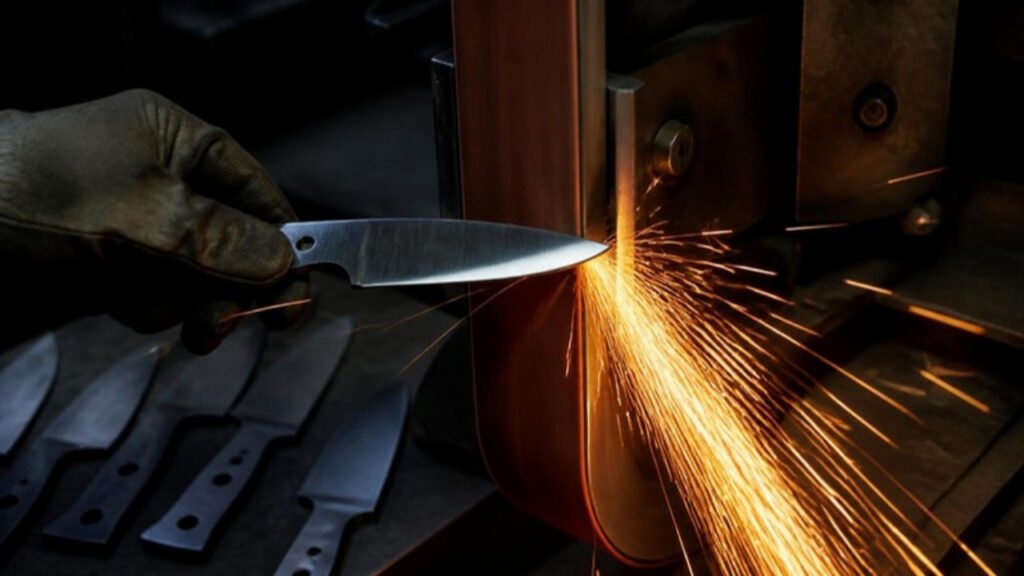
Step 4: Grinding and Sharpening
Next comes blade grinding. The bevels are ground, the edge is sharpened, and the blade is polished or finished. A careful grind decides how well the knife cuts.
Step 5: Handle Making and Assembly
A handle in wood, rosewood, stag horn or micarta is shaped and fitted, then the knife is assembled and cleaned. A good handle makes the knife comfortable and safe to use.
Step 6: Quality Inspection
Finally, each knife goes through a quality inspection. The edge, the finish and the handle fit are checked before the knife is packed.
Knives We Make
The same care goes into every product: kitchen knives, hunting knives, pocket knives, axes and swords. Our Damascus knives are especially popular with collectors and cooks. You can learn more in our guides on handmade knife manufacturing and power hammer forging.
Custom, OEM and Wholesale Knives
We also work with businesses as an OEM knife manufacturer. If you need custom knives, private label knives or wholesale knives with your own design and branding, see our wholesale and bulk orders page or request a quote.
Frequently Asked Questions
How are knives made?
Knives are made by selecting steel, forging or cutting the blade shape, heat treating it, grinding and sharpening the edge, fitting a handle, and finishing with a quality check.
What is the best steel for a knife?
It depends on use. High carbon steel gives great edge retention, stainless steel resists rust, and Damascus steel combines performance with a beautiful pattern.
Are your knives handmade?
Yes. Bodacious Knives are handmade by experienced craftspeople, and we are a registered USA-based company.
Final Thoughts
Seeing how knives are made helps you understand why quality knives cost what they do and why they last. Whether you want a kitchen knife, a hunting knife or something custom, Bodacious Knives would be proud to make it for you.
Explore our collection: Hunting & EDC Knives | Kitchen Knives | Pocket Knives | Axes | All Categories